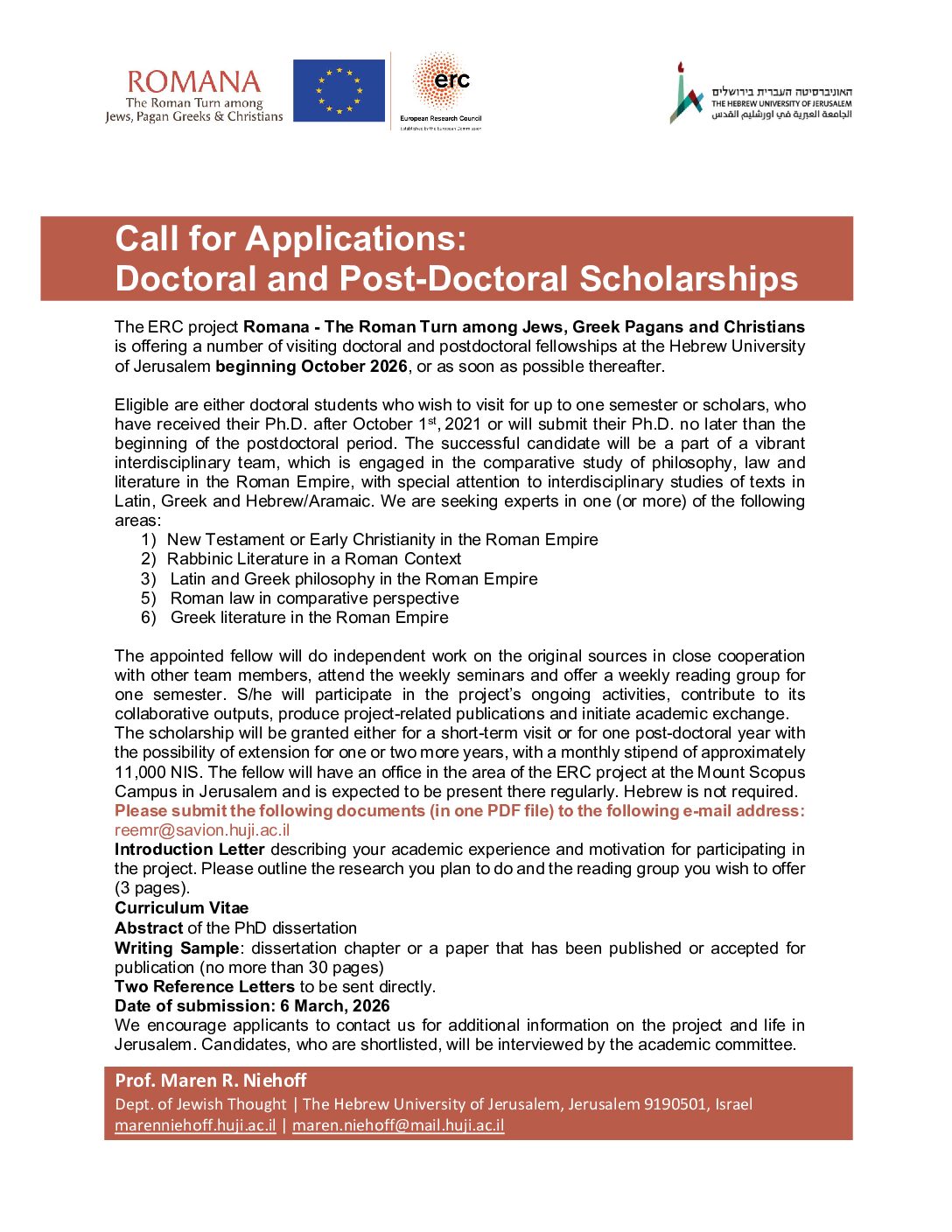
First Steps towards a Tailored LLM for Greek and Latin Scientific Texts (Hybrid Workshop)
First Steps towards a Tailored LLM for Greek and Latin Scientific Texts (Hybrid Workshop)
פרטי אירוע
מוזמנות ומוזמנים להשתתף בסדנה בינלאומית היברידית (אפשר גם אונליין) לבניית תשתית למודל שפה ייעודי לחיבורים מדעיים ביוונית ולטינית.
הסדנה מעשית ומיועדת לחוקרים, לא למתכנתים – עובדים יחד על יצירת מאגר שאלות־ותשובות שישמש לאימון כלי AI ברמה מחקרית.
השתתפות היא הזדמנות להשפיע על עתיד ה–AI במדעי הרוח, לרכוש הבנה מבפנים של איך מודלים כאלה נבנים, ולהצטרף לקהילה שיתופית (כולל קרדיט אקדמי על התרומה).
פרטים נוספים והרשמה במסמך המצורף.
You are warmly invited to participate in an international hybrid workshop (with an online participation option) focused on building the foundation for a specialised language model for scientific texts in Greek and Latin.
This is a hands-on workshop designed for researchers — not programmers. Participants will collaboratively create a curated question-and-answer dataset that will be used to train AI tools at a scholarly level.
Taking part is an opportunity to:
- Help shape the future of AI in the Humanities
- Gain an insider’s understanding of how such models are built
- Join a collaborative research community (and Receive academic credit for your contribution)
Further details are available in the following video: https://lnkd.in/dxGAyQ24 and in the attached document.
Use the following link for registration: https://umfrage.hu-berlin.de/index.php/197924
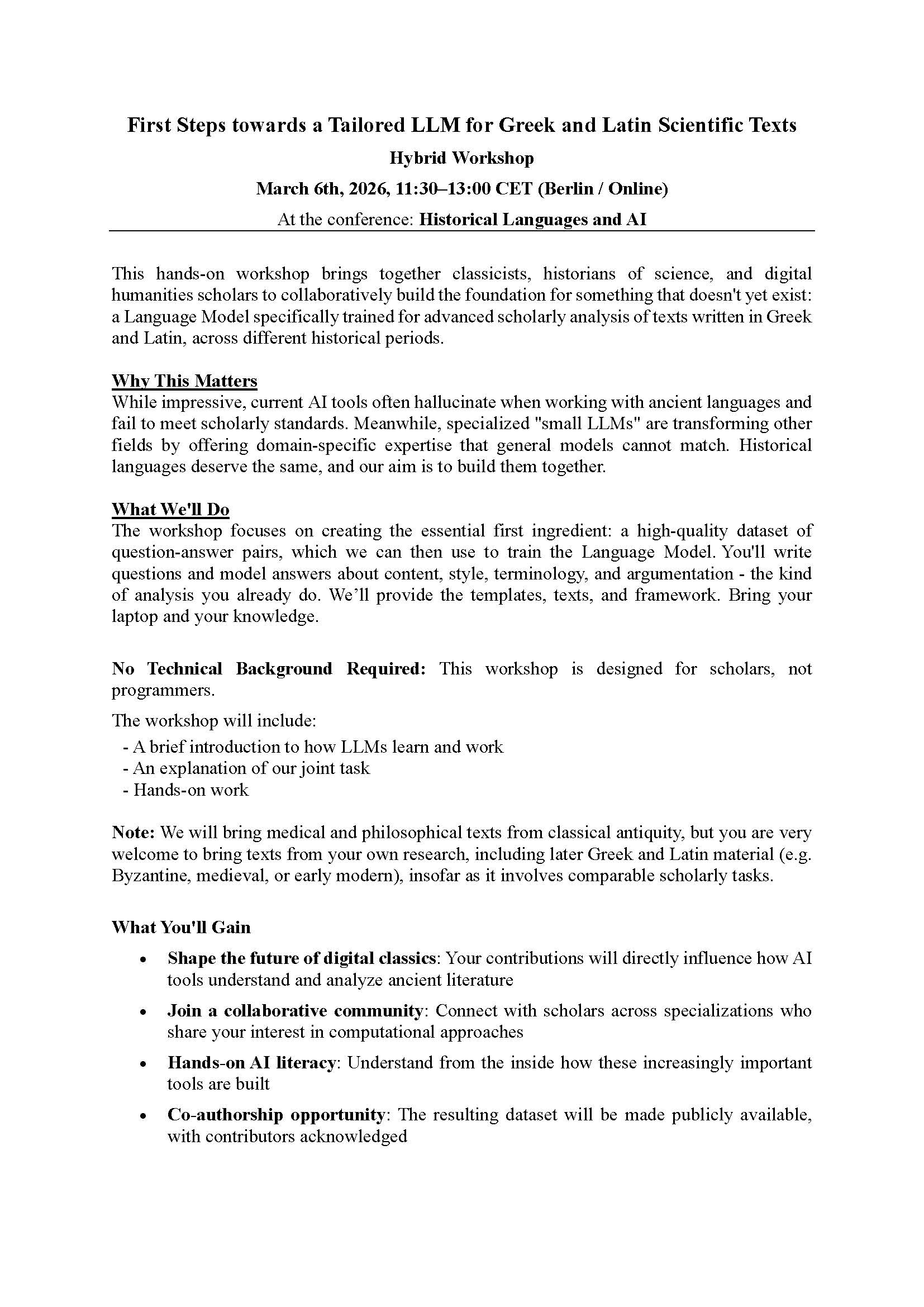
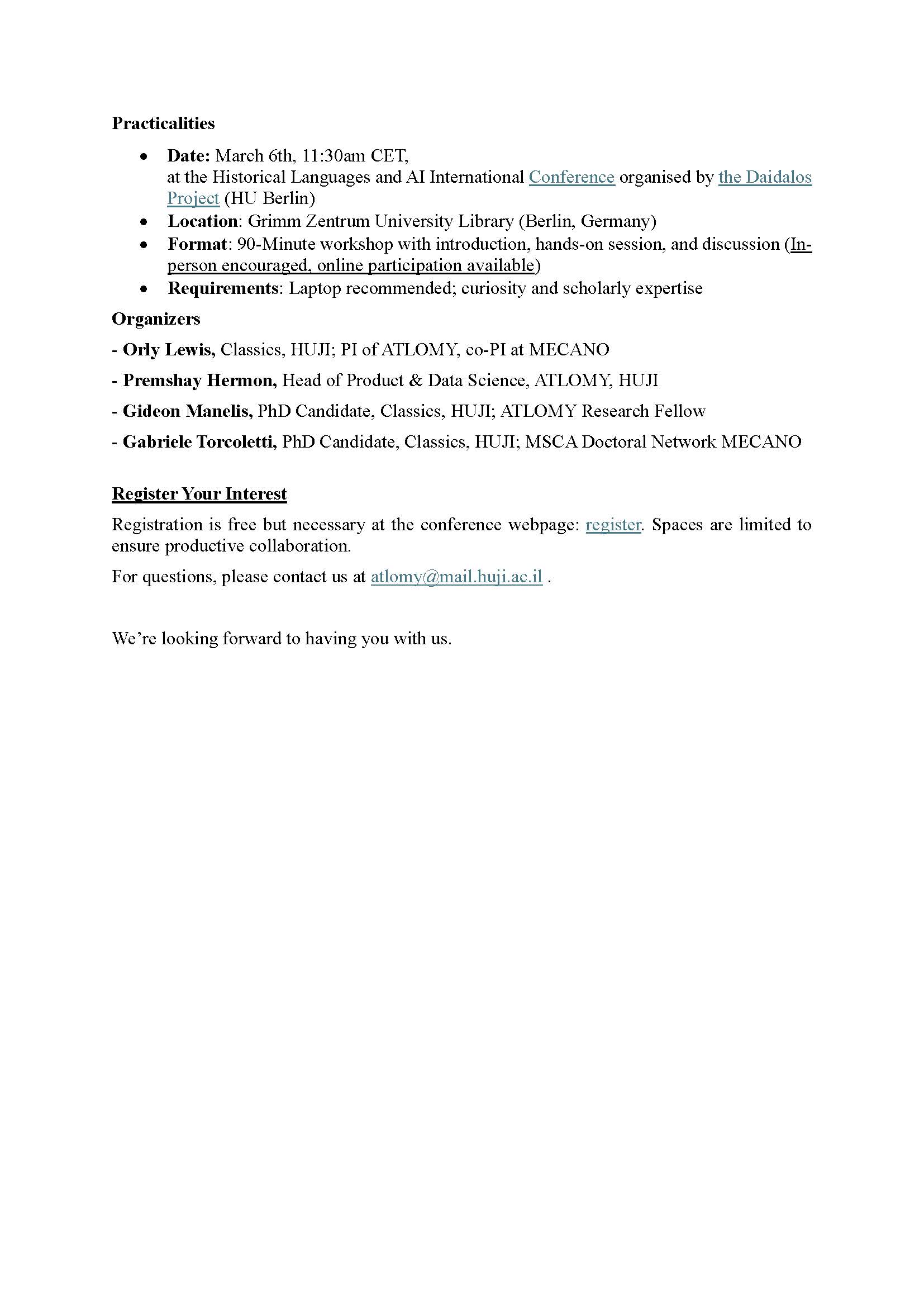
____________________________________________________________________________________________________________________________________________________________________
First Steps towards a Tailored LLM for Greek and Latin Scientific Texts Hybrid Workshop
March 6th, 2026, 11:30–13:00 CET (Berlin / Online)
At the conference: Historical Languages and AI
This hands-on workshop brings together classicists, historians of science, and digital humanities scholars to collaboratively build the foundation for something that doesn’t yet exist: a Language Model specifically trained for advanced scholarly analysis of texts written in Greek and Latin, across different historical periods.
Why This Matters
While impressive, current AI tools often hallucinate when working with ancient languages and fail to meet scholarly standards. Meanwhile, specialized “small LLMs” are transforming other fields by offering domain-specific expertise that general models cannot match. Historical languages deserve the same, and our aim is to build them together.
What We’ll Do
The workshop focuses on creating the essential first ingredient: a high-quality dataset of question-answer pairs, which we can then use to train the Language Model. You’ll write questions and model answers about content, style, terminology, and argumentation – the kind of analysis you already do. We’ll provide the templates, texts, and framework. Bring your laptop and your knowledge.
No Technical Background Required: This workshop is designed for scholars, not programmers.
The workshop will include:
A brief introduction to how LLMs learn and work
An explanation on our joint task
Hands-on work
Note: We will bring medical and philosophical texts from classical antiquity, but you are very welcome to bring texts from your own research, including later Greek and Latin material (e.g. Byzantine, medieval, or early modern), insofar as it involves comparable scholarly tasks.
What You’ll Gain
• Shape the future of digital classics: Your contributions will directly influence how AI tools understand and analyze ancient literature
• Join a collaborative community: Connect with scholars across specializations who share your interest in computational approaches
• Hands-on AI literacy: Understand from the inside how these increasingly important tools are built
• Co-authorship opportunity: The resulting dataset will be made publicly available, with contributors acknowledged
Practicalities
• Date: March 6th, 11:30am CET, at the Historical Languages and AI International Conference organised by the Daidalos Project (HU Berlin)
• Location: Grimm Zentrum University Library (Berlin, Germany)
• Format: 90-Minute workshop with introduction, hands-on session, and discussion (Inperson encouraged, online participation available)
• Requirements: Laptop recommended; curiosity and scholarly expertise
Organizers
– Orly Lewis, Classics, HUJI; PI of ATLOMY, co-PI at MECANO
– Premshay Hermon, Head of Product & Data Science, ATLOMY, HUJI
– Gideon Manelis, PhD Candidate, Classics, HUJI; ATLOMY Research Fellow
– Gabriele Torcoletti, PhD Candidate, Classics, HUJI; MSCA Doctoral Network MECANO
Register Your Interest Registration is free but necessary at the conference webpage: register.
Spaces are limited to ensure productive collaboration. For questions, please contact us at atlomy@mail.huji.ac.il .
We’re looking forward to having you with us.